
Pikeville Recent Arrest Sources
Bledsoe County hosts no sheriff-run arrest log with a clean seven-day or multi-day window. The county's own site gives jail and sheriff contact details but no dated booking table. So the practical trail splits three ways. City notices flow through the official Pikeville Police bulletins. Periodic detention-center arrest reports and case stories live in the Bledsonian-Banner news archive. Regional outlets add coverage of notable operations and investigations. Each stream has its own scope. Pikeville posts selected city notices only. The newspaper reports arrests across stated date ranges, plus single-case stories. Regional pieces usually follow a newsworthy operation. None works as a live county roster, and none can tell you whether a person remains in custody now.
A cluster of postings after a weekend or operation is never a full arrest count. Confirm the booking with the sheriff and the outcome with the court.
Reading Pikeville Arrest Reports
Always work from the source date back to the event. A headline's date can lag behind the arrest. It can lag behind the booking or the alleged incident itself. Keep agency terms distinct. Person of interest, wanted, charged, booked, and held are not interchangeable.
- Open the official city bulletin or attributed news report and note its publication date.
- Find the incident or arrest date stated in the text. Do not infer one from the page date.
- Identify whether the source is Pikeville Police, the Bledsoe County Sheriff Office, the detention center, or a news outlet.
- Record the custody destination only if the source states it. Some Pikeville releases identify Bledsoe County Jail.
- Check the clerk for a case number and disposition. The original alleged charge may change.
The Daily Arrest Report fits same-day checks. This wider log serves periodic publication, older notices, and tracing a story across dates.
Pikeville Arrest Report Fields
City notices and news stories share no common format. One piece may name a charge and court setting. Another may announce a wanted subject or a public-safety event. Record only the fields a source expressly supplies.
| Field | How to read it |
|---|---|
| Source type | Official bulletin, periodic newspaper report, or regional event story. |
| Publication date | When the item appeared, not necessarily when an arrest occurred. |
| Incident or arrest date | Use only the date stated by the source. |
| Agency | The office credited with the investigation or arrest. |
| Status language | Keep wanted, person of interest, charged, booked, and held distinct. |
| Alleged charge | A booking or news charge, never a finding of guilt. |
| Court setting | A scheduled appearance, not the final disposition. |
A later court entry may show dismissal, diversion, amendment, plea, acquittal, or conviction. That record controls any claim about how a case ended.
Pikeville Bulletin Arrest Path
Pikeville Police runs the county's strongest first-party archive of public events. Its bulletins include wanted notices, missing-person alerts, persons of interest, narcotics investigations, and releases reporting an arrest. Open each item and follow its exact wording. Titles alone do not confirm a booking. One September 2025 release traces a complete path. A theft was reported. The city issued a crime bulletin with a suspect image. Police identified the person, filed a formal charge, and booked him into Bledsoe County Jail. That proves a city-to-county handoff can happen. It does not make bulletins a rule. Many routine arrests in Pikeville never get one. The official Pikeville archive appears below as a date-based city source.

The archive mixes several notice types. Treat it as a record of events, never as a blanket list of arrested people.
Pikeville Arrest News Cycles
The Bledsonian-Banner stands as the strongest local newspaper source for Bledsoe County arrests. Its periodic arrest reports cover bounded date ranges drawn from the detention center, the sheriff, and Pikeville Police. Single stories add arrest dates, alleged charges, detention-center references, and General Sessions settings. Those details make the paper valuable for historical discovery. Publication runs in cycles, though. A print issue can group events from many days at once. A standalone article reflects an editor's choice, not the full roster. Weekend incidents may surface in the next issue or a later web post. Holidays shake up agency and newsroom schedules alike. No story simply means no story. The newspaper news section below illustrates this periodic source.
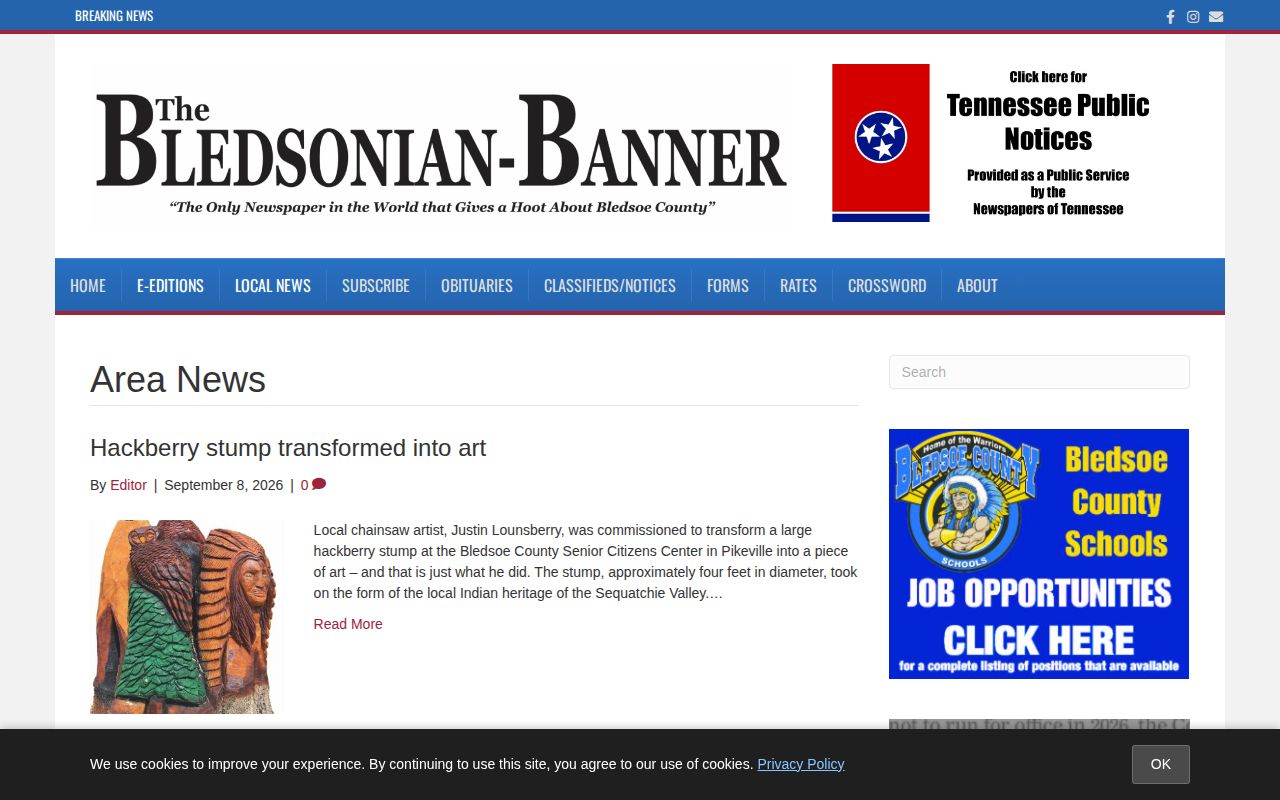
Rely on each article's own date and attribution, then confirm current custody through the official county contact.
One Pikeville Arrest Story
Local news can fill in what a jail roster leaves out. A Bledsonian-Banner story on a Pikeville burglary and theft case shows how. It names the paper, gives an arrest date, and notes detention-center custody. It even lists a General Sessions court date.
The dated newspaper article is shown below for reference. A story like this connects a Bledsoe County arrest to the court calendar that follows it. The clerk of court, though, holds the record of what happened next.
Photo credits deserve a careful eye too. WDEF and WOW Country have run sheriff-office photo credits in Bledsoe stories. A credit tells you where an image came from. It does not make the outlet the keeper of booking photos, and it says nothing about how current the picture is.
Weekend Pikeville Arrest Posts
Bledsoe County agencies post no weekend arrest schedule. The city announces matters when it chooses. The newspaper works on its own story cycle, so a burst of arrest coverage usually reflects timing rather than a spike in Pikeville bookings. Silence for several days means little. Then several stories may land at once, giving the false look of a jump in arrests. Treat checkpoint notices the same way. They set enforcement context but never confirm that anyone was actually arrested there. The Bledsoe Shield described a long countywide crime-suppression effort involving warrants, violent crime, and drugs. That is an operation report. It is not a name-by-name custody roster. For any one person's status, you still need the official record.
Note: Source clusters build local context, but they cannot be totaled into a current jail population or daily arrest count.
Pikeville Arrest Record Archives
Old stories age out fast. Ask the sheriff or the right police custodian for the modern record behind any bulletin. Bledsoe County's Open Records Policy backs a narrow request. Give a person, dates, and record type. Useful fields include the booking record and arresting agency. They also cover the charge entry and any release or transfer data the office can hand over. No county rule fixes how long booking photos are kept.
Older court history takes a different road. The Tennessee State Library and Archives holds Bledsoe Circuit criminal loose-record microfilm from 1970 through 1994. The Bledsoe County Public Library keeps old court and warrant material too. Those repositories serve history, not current jail status or recent mugshots. The local archive page lists these record series. For a modern booking record, the sheriff is still the first stop.
Pikeville Arrest Court Outcomes
For docket help in Pikeville, call the Bledsoe Circuit Court Clerk at 423-447-6488. The courthouse sits at 3150 Main Street. Bring a case number if you have one. Names repeat here. So compare lawful identifiers before trusting a match. Booking charges can shrink or vanish later. A case may be nolled, diverted, bound over, pled out, tried, or acquitted. So an arrest log marks where a case starts, not where it lands.
Pikeville Police Records Contact
Pikeville Police works from 25 Municipal Drive in Pikeville, Tennessee 37367. The police number is 423-447-2585. The city main line is 423-447-2919. Ask the department whether it holds the incident report or the bulletin you saw. The Bledsoe County Sheriff Office holds the county jail intake record. It also holds any releasable booking photograph.